[ad_1]
Older male crickets are higher at getting females to reside with them — but they mate less than youthful rivals as soon as they discover a associate.
Meanwhile youthful males have a more durable time attractive females again to their burrows — but more mating occurs in the event that they succeed.
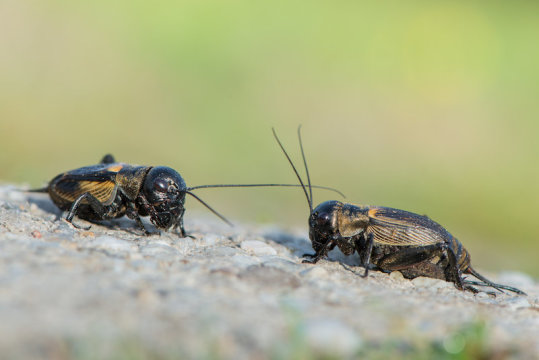
University of Exeter scientists studied subject crickets to see if a male’s age affected how enticing females discovered them.
“Females choose mates to get the best genes for their offspring,” mentioned Dr Rolando Rodríguez-Muñoz of the Centre for Ecology and Conservation on the University of Exeter’s Penryn Campus in Cornwall.
“It’s attainable that the oldest males have one of the best genes as a result of they’ve proven they’ll reside for a very long time.¬
“On the opposite hand, females would possibly favour youthful males whose sperm haven’t accrued probably dangerous mutations that shall be handed on to offspring.
“Our results show a mixed picture, with older males more successful at pairing up with females, but mating less frequently once paired.”
The examine discovered each pairing and mating have been linked to profitable replica, and there was no relationship between a male’s age on the time of mating and what number of offspring he had.
“It seems that the age of a male is a poor guide to his suitability as a mate,” mentioned Professor Tom Tregenza.
“This was reflected in the opposing effects it had on their success in pairing up and mating with females.”
The grownup lifetime of subject crickets final only a few weeks, but earlier analysis confirmed males “get old” within the sense of declining as they age.
Choosing an older male would possibly look like a very good technique for locating a long-lived male, but the brand new examine discovered this was solely partially efficient — as youthful males could reside to the identical and even older ages than people who emerged earlier within the yr than them.
The examine used ten years of video monitoring of all of the crickets in a Spanish meadow.
The Exeter researchers have simply launched a web-based sport, Cricket Tales (http://cricket-tales.ex.ac.uk). Players will assist analyse over one million hours of movies of crickets to know how bugs could also be affected by local weather change.
The paper, printed within the journal Animal Behaviour, is entitled: “Older males attract more females but get less matings in a wild field cricket.”
Story Source:
Materials offered by University of Exeter. Note: Content could also be edited for type and size.
[ad_2]